Zhong Lian
Zhong Lian, Sichuan University, Chengdu, PR China
Short biography: Zhong Lian, a professor at Sichuan University, has been selected for the Youth Program of the Thousand Talents Plan by the Central Organization Department, the Thousand Talents Plan of Sichuan Province, and has been recognized as an academic leader by the Sichuan Provincial Health Commission. He obtained his bachelor's degree in 2009 from East China Normal University, under the supervision of Prof. Hong Ran (Shanghai Institute of Organic Chemistry); in 2012, he earned his master's degree from the Shanghai Institute of Organic Chemistry, under the guidance of Prof. Shi Min; and in 2015, he completed his PhD at Aarhus University in Denmark, under the supervision of Prof. Troels Skrydstrup. From 2016 to 2018, he conducted postdoctoral research in the Prof. Bill Morandi’s research group at the Max Planck Institute for Coal Research in Germany. Since May 2018, he has been a full professor at Sichuan University. His main research focuses on mechanical synthetic chemistry.
Mechanical Synthetic Chemistry
Zhong Lian
National Key Laboratory of Biotherapy, West China Hospital, Sichuan University
e-mail: lianzhongchem@163.com
Keywords:Mechanochemistry, Piezoelectric catalysis
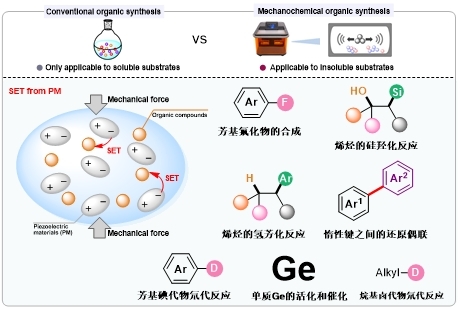
Mechanochemistry, a green and sustainable approach to chemical synthesis conducted under solvent-free or solvent-minimized conditions, has had a profound impact on synthetic chemistry. The piezoelectric effect describes how certain crystalline materials, when subjected to mechanical stress, undergo changes in their internal charge distribution that generate an electric field or voltage. Under mechanical force, polarized piezoelectric materials facilitate single-electron transfer reactions, opening new avenues for radical-based solid-state synthesis. Leveraging this principle, we have achieved the Balz–Schiemann reaction and the hydroxysilylation of alkenes under mild conditions. We have also developed a novel piezo-catalytic pathway—continuous mechanical force–induced electron transfer (ConMET)—enabling dehalogenative deuteration of aryl and alkyl halides and the hydroarylation of alkenes. In addition, we have utilized mechanical force to activate and catalyze elemental germanium and to promote reductive coupling reactions between aryl fluorides and aryl ethers, among other transformations.
Reference
- Wang, X.-H.; He, X.-C.; Zhang, X.-M.; Wang, Q.-Q.; Huang, Q.; Qu, R.-L.; Lian, Z. Nat. Commun. 2025, 16,5200.
- Qu, R.-L.; Wan, S.; Zhang, X.-M.; Wang, X.-H.; Xue, L.; Wang, Q.-Q.; Cheng, G.-J.; Dai, L.-Z.; Lian, Z. Angew. Chem. Int. Ed. 2024, e202400645.
- Wang, X.-H.; Zhang, X.-M.; He, X.-C.; Guo, G.-Q.; Huang, Q.; You, F.-Z.; Wang, Q.-Q.; Qu, R.-L.; Zhou, F.; Lian, Z. Angew. Chem. Int. Ed. 2024, e202410334.
- Guo, G.-Q.; Zhou, J.; He, X.-C.; Li, N.; Lin N.; Zhang, X.-M.; Lian Z. Angew. Chem. Int. Ed. 2025, e202421446.
- Liu, T.-F.; Zhang, X.-M.; Wang, Q.-Q.; Lian, Z. Angew. Chem. Int. Ed. 2025, e202424186.