Thomas J. J. Müller
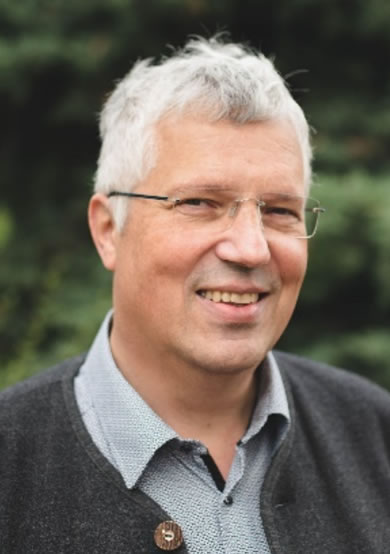
Thomas J. J. Müller, Heinrich Heine University Düsseldorf, Germany
Short biography (150-200 words): Thomas J. J. Müller, born in Würzburg, Germany, in 1964, studied chemistry (1984-1989) at the University of München (LMU) (diploma 1989; Ph.D. 1992). After a post-doctoral stay at Stanford University (1993/1994) as a Feodor Lynen fellow (Alexander von Humboldt foundation), he developed his independent research at Technical University Darmstadt and LMU (1994-1999; habilitation 2000) (as recipient of the Liebig fellowship of the Funds of Chemical Industry and the habilitation scholarship of DFG). After a professorship at the University of Heidelberg (2002-2006) he is a chaired full professor at the University of Düsseldorf since 2006, and since 2019 the spokesman of the Research Training Group 2482 funded by the German Science Foundation (DFG). In 2013 he was awarded with First Prize of Evonik Call for Research Proposals (ECRP). He was a member of the board of Liebig Society of Organic Chemistry for two election periods (2016-2023). Since 2021 he is a foreign member of the National Academy of Sciences of Ukraine. He was elected in 2023 as a member of the DFG decision panel on funding of projects in chemistry. He is member of board of several foundations and selection committees. His research interests encompass synthetic and physical-organic chemistry of functional chromophores, and the design of novel one-pot reactions, documented in more than 350 publications.
SEQUENTIALLY PD-CATALYZED PROCESSES – CONSECUTIVE MULTICOMPONENT SYNTHESIS OF FUNCTIONAL MOLECULES IN CATALYST ECONOMIC FASHION
Thomas J. J. Müllera
a Heinrich Heine University Düsseldorf, Faculty of Mathematics and Natural Sciences, Institute of Organic Chemistry and Macromolecular Chemistry, Universitätsstr. 1, D-40225 Düsseldorf, Germany
e-mail: thomasjj.mueller@hhu.de
Keywords:anti-infectiva, apoptosis inducers, catalysis, consecutive reactions, functional chromophores, multicomponent reactions, palladium
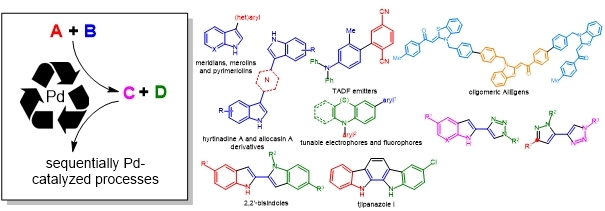
One-pot reactions – in a consecutive, sequential or domino fashion – are highly efficient and efficacious routes to functional molecules in life and materials sciences. Heterocyclic systems cover a vast spectrum of applications and are therefore highly interesting. Transition metal catalyzed multi-component sequences have raised considerable attention since they enable transformations with high tolerance of functional groups.[1]Likewise, sequentially Pd-catalyzed processes have opened new avenues to one-pot syntheses of numerous classes of heterocyclic frameworks.[2-4] This one-pot methodological concept, in particular the Masuda-Suzuki sequence,[5] is most elegantly applied to the syntheses of various classes of functional heterocycles, ranging from functional chromophores to the key steps in very concise syntheses of marine alkaloids,[6,7] kinase inhibitors,[8] and anti-infectiva.[9,10]
References
[1] D. M. D’Souza, T. J. J. Müller, Chem. Soc. Rev. 2007, 36, 1095–1108.
[2] T. J. J. Müller,Top. Organomet. Chem.2006, 19, 149–205.
[3] T. Lessing, T. J. J. Müller,Appl. Sci.2015, 5, 1803–1836.
[4] M. M. Kornet, T. J. J. Müller, Molecules 2024, 29, 5265.
[5] M. Kruppa, T. J. J. Müller, Catalysts2023, 13, 350.
[6] S. Kustosz, P. Niesobski,T. J. J. Müller, ChemCatChem 2021, 13, 217–220.
[7] M. Kruppa, T. J. J. Müller,Molecules 2023, 28, 947.
[8] K. S. Krings, T. R. Wassenberg, P. Cea-Medina, L. Schmitt, I. Lechtenberg, T. R. Llewellyn, N. Qin, H. Gohlke, S. Wesselborg, T. J. J. Müller, Molecules 2024, 29, 6050.
[9] N. Rehberg, G. A. Sommer, D. Drießen, M. Kruppa, S. Chen, E. T. Adeniyi, L. Wang, K. Wolf, B. O. A. Tasch, T. R. Ioerger, K. Zhu,T. J. J. Müller, R. Kalscheuer, J. Med. Chem. 2020, 63, 12623–12641.
[10] E. Adeniyi, M. Kruppa, S. DeBenedetti, K. Ludwig, V. Krisilia, T. Wassenberg, M. Both, T. Schneider, T. J. J. Müller, R. Kalscheuer, ACS Infect. Dis. 2024, 10, 1958–1969.