Romano V. A. Orru
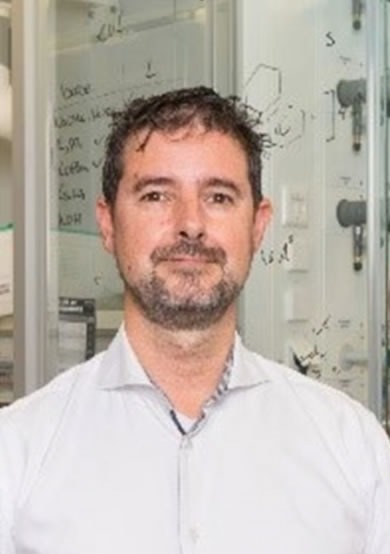
Romano V. A. Orru, Vrije Universiteit Amsterdam, The Netherlands
Short biography: Romano Orru completed his PhD in organic chemistry at the Agricultural University of Wageningen, The Netherlands. From 1996 to 2000 he worked at the Technical as well as at the Karl-Franszens University of Graz, Austria on synthetic applications of bio-transformations.
In 2000, he returned to the Netherlands, and was appointed Assistant Professor and later Associate Professor (2003) of Synthetic & Bioorganic Chemistry at Vrije Universiteit Amsterdam, where he was appointed chair in 2007. End of 2019 he moved to the AachenMaastricht Institute for Biobased Materials of Maastricht University as a professor of Organic Chemistry. Early 2022 he became the Scientific Director of AMIBM. His research focuses on the utilisation of one-pot cascade reactions and multi-component reactions to improve the efficiency, sustainability and precision of organic compound synthesis, with emphasis on applications in the field of pharmaceutical science. For that, he develops novel MCRs and employs them in combination with biocatalysts in one-pot processes to access targeted molecules in a stereoselective fashion. In another research line he develops isocyanides as versatile C1 building blocks in (transition) metal-catalyzed insertion reactions towards privileged heterocyclic scaffolds. He is considered a leader in his field and has contributed much to this emerging area.
ISOCYANIDES: CHEMICAL CHAMELEONS
Romano V.A. Orru,a
a the Aachen-Maastricht Institute for Biobased Materials (AMIBM)
Faculty of Science & Engineering, Maastricht University
Brightlands Chemelot Campus, Center Court, Urmonderbaan 22, 6167 RD,
Geleen, The Netherlands
e-mail: r.orru@maastrichtuniversity.nl
Keywords:isocyanides, spirocyclizations, photochemistry, alkaloids, peptoids,
In the past 15 years we worked on a number of Tandem- and Multi Component Reaction strategies that involve isocyanides. We discovered many interesting new reactions that were applied in a range of chemistry fields, covering medicinal and combinatorial chemistry, catalysis, biotransformations, fotochemistry and natural product synthesis. We have explored classical MCR approaches where isocyanides can act as both electrophiles as well as nucleophiles, biocatalytic asymmetric Ugi-type transformations, but also both transition-metal as well as base-metal mediated and catalyzed insertion chemistry. Recently, we embarked on radical-type chemistry involving isocyanides discovering remarkable charge-transfer behavior in (auto) photocatalysis. In this presentation I will highlight the fascinating chameleonic behavour of isocyanides and show their remarkable value as C1-building blocks in synthetic organic method development.
References
[1]DOI: 10.1039/D3SC06304F (Edge Article) Chem. Sci., 2024, 15, 6867-6873.
[2] DOI: 10.1016/j.xcrp.2025.102860Cell Reports Physical Science, 2025, 6 (10) 102860
[3] DOI: https://doi.org/10.1002/anie.201905838, Angew. Chemie, int. ed. Engl.,2020, 59 (2), 540-558
[4] DOI: https://doi.org/10.1039/C4GC00013G, Green Chem., 2014,16, 2958-2975