Xiu-Qin Dong

Xiu-Qin Dong, College of Chemistry and Molecular Sciences, Wuhan University, PR China
Short biography: Xiu-Qin Dong received her PhD degree from Wuhan University in 2012 supervised by Prof. Chun-Jiang Wang. After postdoctoral research at the Hong Kong University of Science and Technology with Prof. Jianwei Sun (2012-2014), she joined the College of Chemistry and Molecular Sciences at Wuhan University as an associate professor in 2015, and was promoted to full professor in 2023. Her research interests mainly focused on the development of chiral ligands, asymmetric hydrogenation, asymmetric catalytic reactions, asymmetric synergistic catalysis. She has published over 100 publications as the corresponding author in top-tier journals such as Acc. Chem. Res., J. Am. Chem. Soc., Angew. Chem. Int. Ed., Nat. Commun., CCS Chem., Fundam. Res., Chem. Sci., ACS Catal., etc. She received the National Young Talents Support Program, Hubei Province Chutian Scholar Program (Chutian Scholar - Rising Star) and Distinguished Youth Fund of Hubei Province.
Efficient Construction of Chiral Molecules via Cooperative Catalysis
Xiu-Qin Donga
aCollege of Chemistry and Molecular Sciences, Wuhan University
e-mail: xiuqindong@whu.edu.cn
Keywords:cooperative catalysis, non-covalent interactions, asymmetric catalytic reactions…
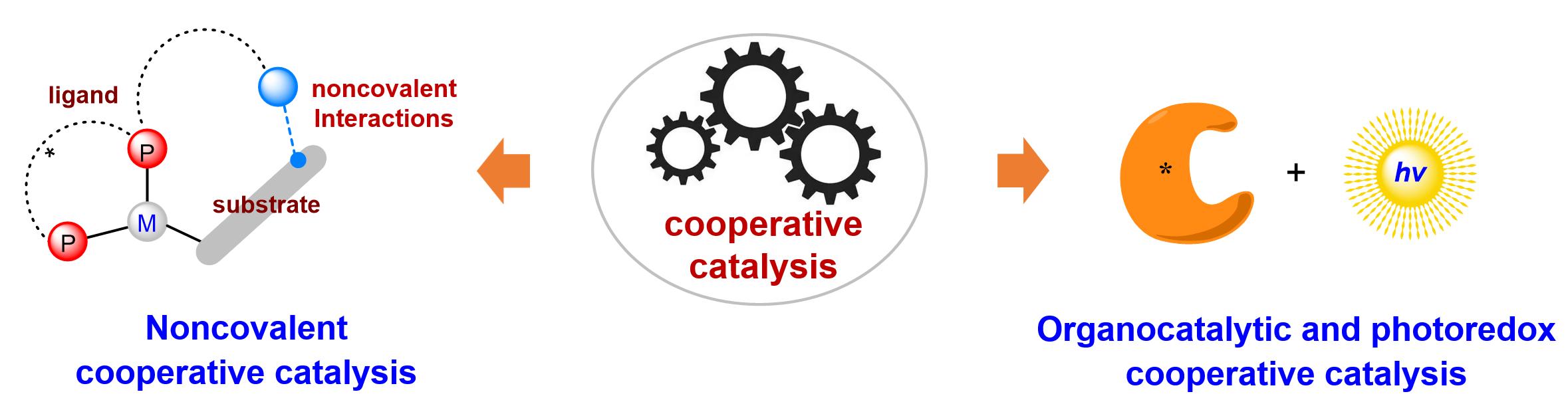
Based on cooperative catalysis strategy, our research group focuses on the development of novel chiral phosphine ligands and efficient asymmetric catalytic systems for the efficient synthesis of chiral molecules. Our research work mainly focused on the following two aspects: (1) Developing new chiral bisphosphine ligands based on non-covalent ion-pair and hydrogen-bond cooperative catalysis strategies. By introducing non-covalent interactions into the ligands, the interaction between the ligands and reaction substrates is enhanced, which could provide favorable chiral induction environment and improve reaction reactivity. These ligands have been applied to a series of asymmetric hydrogenation reactions, efficiently synthesizing a variety of structurally diverse chiral molecules with excellent reaction results;¹⁻² (2) Efficiently constructing multifunctionalized chiral molecules based on a synergistic catalytic system combining organocatalysis and photocatalysis.³ Additionally, we realizedstereodivergent synthesis of structurally important chiral molecules bearing multiple stereocenters using bimetallic synergistic catalytic system.⁴ We made an effort to the precise assembly of diverse chiral scaffolds, mechanistic investigations, and applying these methodologies to develop new synthetic routes for important chiral pharmaceuticals and bioactive molecules.
References
[1] Q. Zhao, C. Chen, J. Wen, X.-Q. Dong, X. Zhang, Acc. Chem. Res.2020, 53, 1905.
[2] Selected examples: (a) C. Chen, H. Wang, Z. Zhang, S. Jin, S. Wen, X.-Q. Dong, X. Zhang, Chem. Sci.2016, 7, 669; (b) C. Chen, Z. Zhang, S. Jin, S. Wen, L. W. Chung, X.-Q. Dong, X. Zhang, Angew. Chem. Int. Ed.2017, 56, 6808; (c) Z. Han, G. Liu, X. Yang, X.-Q. Dong, X. Zhang, ACS Catal.2021, 11, 7281; (d) Z. Han, G. Liu, X.-Q. Dong, X. Zhang, Chem. Sci.2019, 10, 4328; (e) G. Liu, H. Zhang, Y. Huang, Z. Han, G. Liu, X.-Q. Dong, X. Zhang, Chem. Sci.2019, 10, 2507; (f) Y. Liu, Z. Yi, M. Wang, X.-Q. Dong, X. Zhang, ACS Catal.2020, 10, 11153; (g) G. Liu, L. Zheng, K. Tian, L. W. Chung, X. Zhang, X.-Q. Dong, CCS Chem.2023, 5, 1398; (h) G. Liu, X. Yang, P. Gu, M. Wang, X. Zhang, X.-Q. Dong, J. Am. Chem. Soc.2024, 146, 7419.
[3] (a) Y.-N. Lu, C. Che, G. Zhen, X. Chang, X.-Q. Dong, C.-J. Wang, Chem. Sci.2024, 15, 6507; (b) K. Tian, F. Xiang, J.-L. Huang, Y.-W. Song, M. Wang, C.-J. Wang, X.-Q. Dong, Sci. China Chem. 2025, 68, 5776.
[4] Selected examples: (a) Z.-Y. Yi, L. Xiao, X. Chang, X.-Q. Dong, C.-J. Wang, J. Am. Chem. Soc.2022, 144, 20025; (b) C. Fu, L. He, H. Xu, Y. Dang, X.-Q. Dong, C.-J. Wang, Nat. Commun.2024, 15, 127; (c) K. Tian, X. Chang, L. Xia, X.-Q. Dong, C.-J. Wang, Fundam. Res.2024, 4, 77; (d) T. Chen, Q. Xiong, H. Xu, Y. Dang, X.-Q. Dong, C.-J. Wang, J. Am. Chem. Soc.2024, 146, 29928; (e) Q. Xiong, B.-B. Chen, X.-Q. Dong, C.-J. Wang, J. Am. Chem. Soc.2025, 147, 26108; (f) K. Tian, X.-Q. Dong, C.-J. Wang, J. Am. Chem. Soc.2025, 147, 33288; (g) L. Xiao, Q. Xiong, H. Xu, Z. Wang, X. Chang, Y. Dang, X.-Q. Dong, C.-J. Wang, CCS Chem.2025, 7, 1112; (h) K. Tian, Z. Jin, X.-L. Liu, X.-Q. Dong, C.-J. Wang, Chem. Sci.2025, 16, 1233;(i) Q. Xiong, K. Tian, X.-L. Liu, X.-Q. Dong, C.-J. Wang, Angew. Chem. Int. Ed.2025, 64, e202519537.