Xinyuan Liu
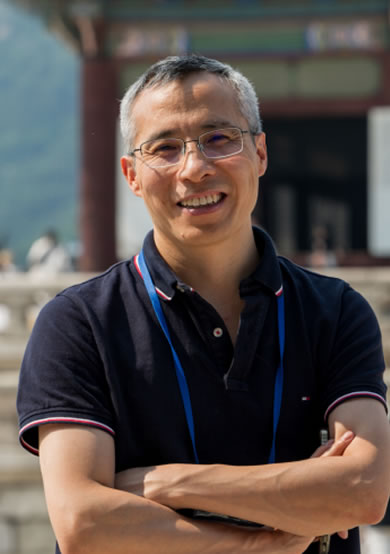
Xinyuan Liu, Southern University of Science and Technology, PR China
Short biography:
Prof. Dr. Xin-Yuan Liu, Chair Professor and Department Head of Chemistry at SUSTech. As the corresponding author, he has published over 110 papers on "Asymmetric Catalytic Radical Chemistry" in top-tier journals such as Science (1), Nature (1), Nat. Chem. (5), Nat. Catal. (3), Nat. Synth. (2), Chem (2), JACS (13), Angew. Chem. (21), etc. He has obtained many honors and awards, such as XPLORER prize, The First-Class Prize of the Natural Science Award of Guangdong Province, Boehringer Ingelheim Lectureship (Boston College), The National Science Fund for Distinguished Young Scholars, The National Science Fund for Excellent Young Scholar, The Scholar Program-Youth Project (Ministry of Education, China), CCS-BASF Innovation Prize, CCS Youth Chirality Award, The Distinguished Lectureship Award (Chemical Society of Japan), CAPA Distinguished Faculty Award (CAPA), ACP Lectureship Awards (Taiwan District, Japan and Korea), etc.
Cu/Chiral Anionic Ligand-Catalyzed Enantioselective Cross-Couplings
Xin-Yuan Liu
Department of Chemistry, Southern University of Science and Technology,ShenZhen, China.
liuxy3@sustech.edu.cn
Keywords:Radical, Chiral Anionic
Radical reactions have emerged as one of the most powerful and efficient tools for the construction of carbon–carbon and carbon–heteroatom bonds in organic synthesis. However, the development of catalytic asymmetric radical reactions to realize the stereochemical control of open-shell intermediates still remains a formidable challenge owing to the high reactivity of such free radical species. To solve this problem, our group has developed copper(I)/chiral anionic ligand catalyst to achieve a number of enantioselective radical transformations: such as the C–H functionalization, alkene difunctionalization and cross–coupling of alkyl halides, etc. The role of chiral anionic ligand is dual: it not only tunes the reducing capability of copper for the reaction initiation but also provides excellent stereocontrol induction of the reactive radical species through multiple models.
References
[1]Zhang, Y.-F.; Wang, B.; Chen, Z.; Liu, J.-R.; Yang, N.-Y.; Xiang, J.-M.; Liu, J.; Gu, Q.-S.; Hong, X.;* Liu, X.-Y.*Science2025, 388, 283.
[2]Chen, J.-J.; Fang, J.-H.; Du, X.-Y.; Zhang, J.-Y.; Bian, J.-Q.; Wang, F.-L.; Luan, C.; Liu, W.-L.; Liu, J.-R.; Dong, X.-Y.; Li, Z.-L.; Gu, Q.-S.; Dong, Z.; Liu, X.-Y.*Nature2023, 618, 294.
[3]Tian, Y.; Li, X.-T.; Liu, J.-R.; Cheng, J.; Gao, A.; Yang, N.-Y.; Li, Z.; Guo, K.-X.; Zhang, W.; Wen, H.-T.; Li, Z.-L.; Gu, Q.-S.; Hong, X.; Liu, X.-Y.*Nat. Chem.2024, 16, 466.
[4]Cheng, Y.-F.; Yu, Z.-L.; Tian, Y.; Liu, J.-R.; Wen, H.-T.; Jiang, N.-C.; Bian, J.-Q.; Xu, G.-X.; Xu, D.-T.; Li, Z.-L.; Gu, Q.-S.;* Hong, X.;* Liu, X.-Y.*Nat. Chem.2023, 15, 395.
[5]Wang, F.-L.; Yang, C.-J.; Liu, J.-R.; Yang, N.-Y.; Dong, X.-Y.; Chang, X.-Y.; Li, Z.-L.; Xu, G.-X.; Yuan, D.-L.; Zhang, Y.-S.; Gu, Q.-S.;* Hong, X.;* and Liu, X.-Y.*Nat. Chem.2022, 14, 949.
[6]Dong, X.-Y.; Zhang, Y.-F.; Ma, C.-L.; Gu, Q.-S.; Wang, F.-L.; Li, Z.-L.; Jiang, S.-P.; Liu, X.-Y.*Nat. Chem.2019, 11, 1158.