Wanqing Wu
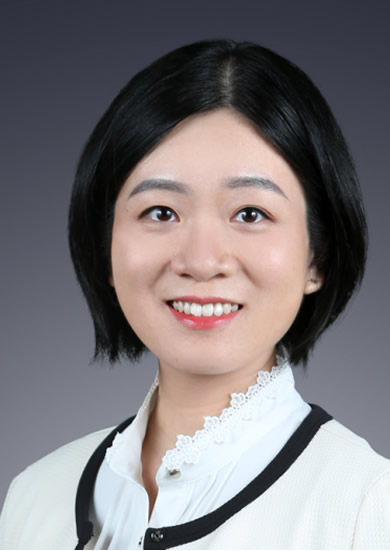
Wanqing Wu, South China University of Technology, Guangzhou, PR China
Short biography:
Wanqing Wu received her Bachelor’s degree from Hunan University in 2005 and her Ph.D. from Peking University in 2010. She then conducted postdoctoral research at South China University of Technology from 2010 to 2013, after which she joined the faculty. She was promoted to Professor in 2014. Her research focuses on the efficient conversion and high-value utilization of unsaturated compounds. To date, she has published over 100 papers in journals such as Acc. Chem. Res., J. Am. Chem. Soc., and Angew. Chem. Int. Ed., and has been granted more than 10 patents. She also received the First Prize of the Natural Science Award from the Ministry of Education (as the third contributor). Her honors include selection for the National Youth Talent Program, the Guangdong Outstanding Young Scientist, the Guangdong Excellent Youth Team, the ChemComm Emerging Investigators, and the Thieme Chemistry Journals Award.
Heteroatom-Promoted Sequential Conversions of Unsaturated Hydrocarbons
Wanqing Wua
aKey Laboratory of Functional Molecular Engineering of Guangdong Province, School of Chemistry and Chemical Engineering, South China University of Technology,Guangzhou 510640, China
e-mail: cewuwq@scut.edu.cn
Keywords: Heteroatom, Unsaturated Bonds, Sequential Conversion
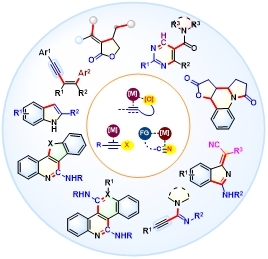
Unsaturated bonds are important functional groups in organic chemistry. Many useful compounds can be synthesized by the sequential conversion of unsaturated bonds. However, due to the diversity of reaction sites and complex reaction modes of unsaturated bonds[1], it is still a challenge to realize their selective conversions and high-value applications. In recent years, we have developed a series of unique strategies for unsaturated bond conversions involving the directing effect of heteroatoms. By introducing different oxygen-[2], nitrogen-[3] and halogen-atoms[4] into the unsaturated bonds, the orderly coordination between the substrates and transition metals was promoted and precise control of reaction selectivity was realized. Moreover, some novel molecules with excellent biological reactivities and fluorescence performance have been constructed and applied.
References
- (a) McDonald, R. I.; Liu, G.; Stahl, S. S. Chem. Rev.2011, 111, 2981. (b) Sun, J. Deng, L. ACS Catal. 2016, 6, 290.
- (a) Ouyang, L.; Li, J.; Zheng, J.; Huang, J.; Qi, C.; Wu, W.; Jiang, H. Angew. Chem. Int. Ed. 2017, 56, 15926. (b) Guo, W.; Liao, J.; Liu, D.; Li, J.; Ji, F.; Wu, W.; Jiang, H. Angew. Chem. Int. Ed. 2017, 56, 1289.(c) Liu, C.; Tan, X.; Zhan, L.; Jing, Y.; Wu, W.; Ke, Z.; Jiang, H. Angew. Chem. Int. Ed. 2022, 61, e202215020. (d) Liu, C.; Wu, J.; Tan, X.; Zhang, J.; Wu, W.; Jiang, H. ACS Catal. 2023, 17, 11339.(e) Tang, J.; Zhao, Y.; Jin, Y.; Zhang, L.; Wang, Y.; Wu, W.; Jiang, H. Chin. Chem. Lett. 2025, 36, 110969
- (a) He, D.; Zhuang, Z.; Wang, X.; Li, J.; Li, J.; Wu, W.; Zhao, Z.; Jiang, H.; Tang, B. Z. Chem. Sci. 2019, 10, 7076. (b) Yu, W.; Zhu, B.; Shi, F.; Zhou, P.; Wu, W.; Jiang, H. Angew. Chem. Int. Ed. 2021,60, 1313. (c) Li, M.; Zhang, R.; Gao, Q.; Jiang, H.; Lei, M.; Wu, W. Angew. Chem. Int. Ed.2022, 61, e202208203. (d) Su, S.; Ren, Y.; Jiang, H.; Wu, W. ACS Catal. 2024, 14,12064. (e) Zhan, M.; Zheng, Y.; Jin, Y.; Jiang, H.; Wu, W. Chem. Commun.2024, 60, 2950.(f) Chen, Z.; Wang, Y.; Zhou, Y.; Li, Y.; Xiong, R.; Huang, W.; Jiang, H.; Wu, W. Chin. Chem. Lett. 2025, 111718. (g) Wang, B.; Liu, S.; Chen, T.; Jiang, H.; Wu, W. Org. Lett. 2025, 27, 6316.(h) Huang, W.; Jiang, H.; Wu, W. Chem. Soc.Rev. 2025, 54, 10724.
- (a) Wu, W.; Jiang, H. Acc. Chem. Res. 2014, 47, 2483. (b) Fang, S.; Jiang, G.; Li, M.; Liu, Z.; Jiang, H.; Wu, W. Chem. Commun. 2019, 55, 13769. (c) Fang, S.; Chen, W.; Jiang, H.; Ma, R.; Wu, W. Chem. Commun. 2022,58, 9666. (d) Zeng, C.; Fang, S.; Guo, S.; Jiang, H.; Yang, S.; Wu, W. Org. Lett. 2023, 25, 1409.(e) Fang, S.; Jiang, H.; Wu, W.Chin. J. Chem. 2023, 41, 181. (f) Guo, S.; Qiu, X.; Jiang, H.; Yang, S.; Wu, W. Org. Chem. Front. 2025,12, 5889.(g) Qiu, X.; Ma, R.; Jiang, H.; Wu, W. Org. Lett. 2025, 27, 8118.